French fries are a very common snack food produced through a series of processing steps, including washing, cutting, and frying. Within this production process, frying is not merely a matter of heating potato strips in hot oil; rather, it is a critical stage that directly determines the final texture, color, oil content, and internal structure of the product.
In industrial french fry production, frying temperature and duration must be comprehensively adjusted based on factors such as fry dimensions, potato variety, moisture content, and the specific production equipment used. Improper parameter control can lead to issues—such as excessive browning, a burnt or hard exterior, an undercooked interior, high oil content, or insufficient crispness—even if the preceding steps of washing, cutting, and pre-treatment were performed correctly. Therefore, a proper understanding of the relationship between french fries frying temperature and time is essential for the consistent production of high-quality french fries.
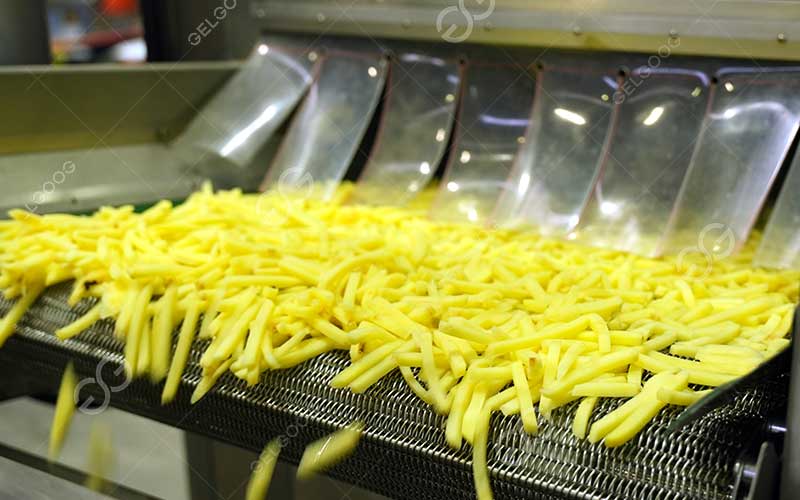
What is the optimal frying temperature for french fries?
In industrial production, french fries are typically fried at relatively high temperatures; however, there is no single standard temperature applicable to every product. Different specifications and processing methods require different temperature profiles.
Generally, the frying temperature is controlled within the range of approximately 160°C to 190°C, depending on product requirements. Common industrial processes often employ a multi-stage frying method to align the temperature with changes in the fries’ internal moisture content.
Frying at lower temperatures results in a slower rate of heat transfer and reduced moisture evaporation efficiency, thereby necessitating a longer processing time. Excessively low temperatures not only lower production efficiency but may also cause the fries to absorb more oil, resulting in a greasy mouthfeel in the finished product.
Conversely, while high frying temperatures facilitate rapid development of surface color and texture, they can lead to a common issue: the outer layer darkens significantly before the interior reaches the desired state. This is particularly problematic for thicker-cut fries, where rapid high-temperature frying can result in an overly dark exterior and a poor internal texture.
Therefore, actual production should not simply aim for high temperatures; instead, the optimal temperature range must be determined based on the specific cut of the fries and the requirements of the final product.
Frying time is equally critical
Beyond temperature, the frying duration directly determines the extent to which the fries are exposed to the heat of the oil.
Generally, thinner fries require a shorter frying time, whereas thicker ones need longer; this is because greater thickness means it takes more time for heat to penetrate to the center.
If the frying time is insufficient, excessive moisture remains inside the fries, causing them to lose their fresh-from-the-fryer crispness upon cooling; additionally, the internal texture may fail to reach the ideal state of doneness.
Conversely, frying for too long—while further reducing moisture—can lead to excessive dehydration. The finished product may become overly hard, dry on the inside, or even excessively dark in color.
Therefore, in actual production, time and temperature must be adjusted in tandem rather than fixing either parameter in isolation.In industrial production, standardized parameter logging allows for the comparison of oil temperature, production speed, and frying time across different batches. When variations in the color or texture of the finished product occur, specific causes can be identified based on production data, rather than relying solely on experience to make adjustments.